Getting started
A tour of your dashboard, by following one order through it
5 minute read
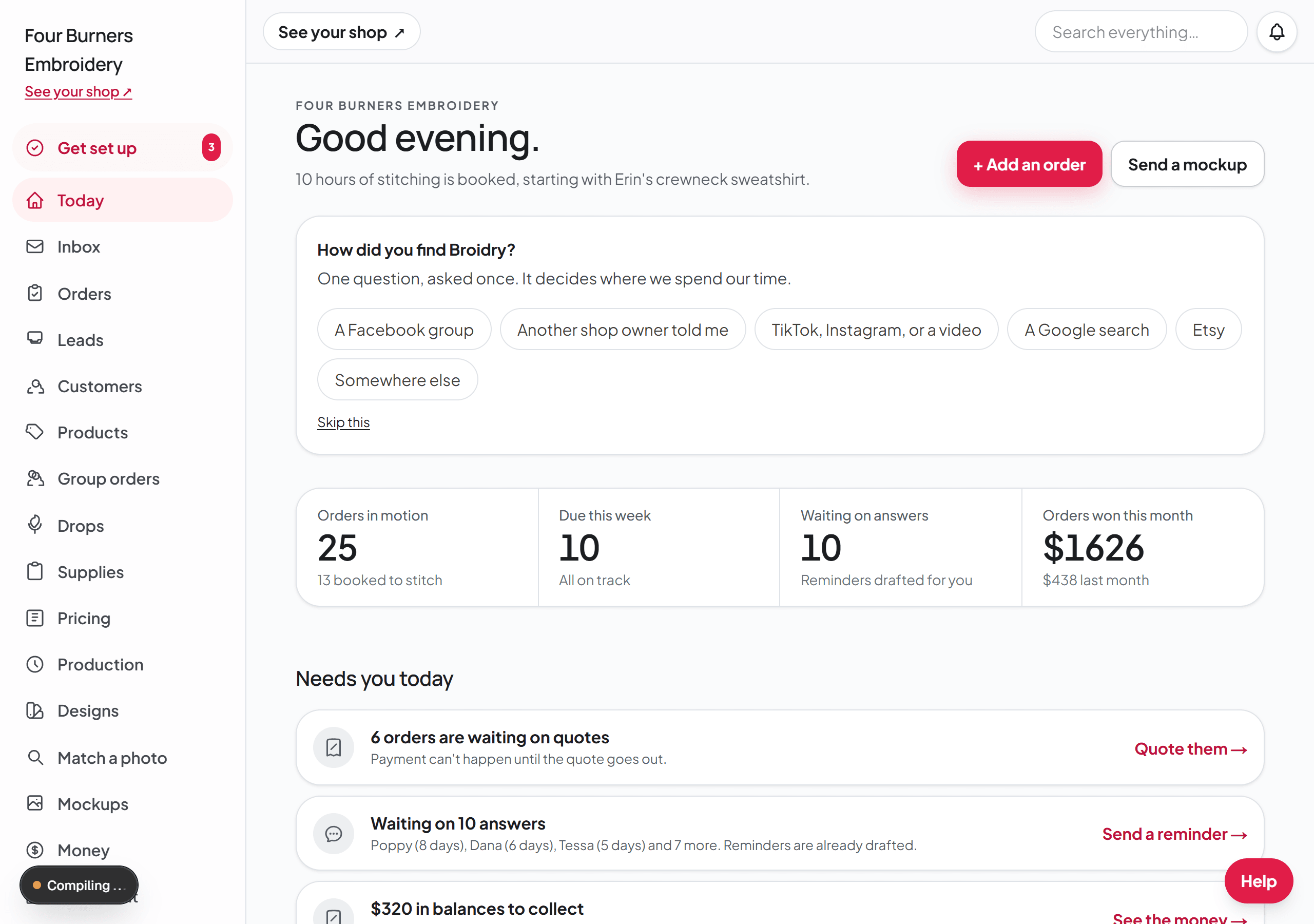
The sidebar has a lot of tabs. Instead of naming them all, this guide walks one order through your shop from the moment someone messages you to the moment you know what you made on it. You will meet each tab where it actually comes up, and you will see that most days you only touch two of them.
The two you will live in are Today and Orders. Everything else is either something you set up once and stop thinking about, or something you open when you want a specific job done.
Before anything: set your prices once
Open Pricing first, before your first order. This is your rate card: what you charge per thousand stitches, your hooping fee, your minimum, your digitizing fee. Every quote Broidry builds pulls from these numbers, so you set them once instead of redoing the math on every order.
Supplies is the other setup tab. It holds your blanks and what each one costs you. You do not have to fill it in to start, but the moment you do, your quotes include your real garment cost and your profit numbers become accurate.
Someone messages you: Leads and Orders
A message on Facebook is not an order yet, it is a maybe. Those live in Leads: a chat you pasted in, a question from your shop page, someone who built a design and did not finish. Every lead comes with a follow-up already written for you, so answering it is reading it and hitting send rather than starting from a blank box.
When the maybe becomes real, it moves to Orders. This is every order you have, from the one that arrived a minute ago to the one you shipped in March. Open any order and everything about it is on one page: what they want, the whole message history, the quote, what they have paid, and anything still missing.
That last part is the one worth knowing about. If the customer never told you a size or a thread color, the order says so at the top, and Broidry writes one message that asks for all of it at once, so you can ask one time instead of going back three separate times.
Before you stitch: Mockups and Designs
Mockups is the Mockup Studio. You put their name on the actual product in the actual font and thread colors, and send it. They approve it on their phone, and the spelling is their responsibility now instead of yours. That approval is what prevents stitching a misspelled name.
Designs is where your stitch files live, with a photo of each one, its true stitched size, and a note of which thread colors you used last time. When a reorder comes in six months later, the answer to which thread you used is already written down. Its neighbor Match a photo goes the other direction: a customer sends you a "can you make me this?" picture, and Broidry helps you figure out which of your designs — or what kind of design — the picture actually is.
Designs earns a second job once you are ready for it: the ones you choose can be offered on your shop page, so a buyer picks a design, picks a garment, and orders the pair without you building a separate product for every combination.
Making it: Production and Today
Production is your make list in the order things are actually due. Broidry uses your machine speed and each design's stitch count to sort what goes on the machine next and to show whether Friday is realistic. Two helpers live off this page: the Run sheet, a printable page that batches everything paid by garment with the thread numbers on it, and Machine mode, a phone-sized view for standing at the machine — what's next, tap Start, tap Done, and the screen stays awake.
Today is the page to open first each morning. It does not list everything; it lists what needs you right now: anything running late, any quote waiting to go out, anyone you are waiting to hear back from, and what is on the machine this week. The people you are waiting on also have their own page, called Chase — who has gone quiet, for how long, and a nudge already written for you to copy. Broidry never sends the nudge itself.
After it ships: Money and Customers
Money is what came in, what is still owed, and what the work actually earned after the blank and the thread. That last number is only accurate when Supplies is filled in.
Customers is your customer book. Every person, every past order, so when someone comes back wanting the same thing in a different color, it is one tap instead of a search through your messages.
The tabs for growing, when you want them
Products is what your shop page sells: photos, colors, sizes, where the embroidery goes, and the price. Storefront controls how that page looks and reads. Together they are your website, and you can ignore both until you want customers ordering without messaging you.
Group orders turns one product into a team store. You send one link, every person picks their own size and name and pays for their own, and you get one production sheet at the end.
Drops is for a themed collection with a closing date, like a holiday run that stops taking orders on the fifteenth. The guide called Drops: a themed collection with one deadline covers it start to finish.
Marketing is the tab for when you want more work rather than more organization: reminders to past customers written from their real orders, a simple email tool, sales and discount codes, review requests, and two print kits — a craft-fair table card and a package insert card, both with a QR code to your shop.
Down at the bottom
Ask Broidry is the chat that answers questions in plain words — both about Broidry itself, like how do I send a mockup, and about your own shop, like which thread you used on a past order or how many hats you made last month. If it can't answer, it sends your question to a real person automatically. Help and feedback goes straight to the people who build Broidry. Billing has your plan and every fee written out, and it is also where you find the Affiliate page if you want to refer other embroiderers and earn a share. Security is your sign-in settings.
Two useful pages do not sit in the sidebar but are always one link away. Import brings your history in from another platform and sets up the Etsy connection — open it from the link on your Today page, or go straight to your dashboard's Import page. And on a phone, the whole dashboard becomes four tabs plus a + button in the middle of the bottom bar; the + is the fastest way to turn a pasted message or a screenshot into an order.